Ruling: Parliament Hill’s Prohibition on Signs Breaches Freedom of Expression
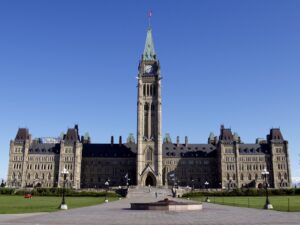
In a powerful victory for the rights that define us as Canadians, the Ontario Superior Court of Justice has ruled that the Parliamentary Protective Service (PPS) in Ottawa violated the Charter protected rights and freedoms of the Campaign Life Coalition (CLC), by banning their graphic pro-life signs from a Parliament Hill press conference in May of 2023.
Justice MacLeod’s reasoning, released in June, made clear that this was no minor operational call. The PPS’s decision breached Section 2(b) of the Canadian Charter of Rights and Freedoms which explicitly protects our freedom of expression and could not be demonstrably justified under Section 1.
At its core, the ruling celebrates a principle we should never take for granted; Canadians have the right to speak plainly and forcefully about the issues that matter most, even when the message is raw, graphic, or deeply unpopular.
The Campaign Life Coalition had organized the event the day before its annual National March for Life. Participants wanted to show what they see as the stark reality of abortion through images of fetal remains, hoping to reach lawmakers and fellow citizens with a moral and political argument.
PPS officers inspected the signs and declared them “too graphic,” invoking Parliament Hill rules against obscene, hateful, violent, or (since 2023) bloody content.
While the group complied with the decision of the PPS, they also refused to stay silent on the matter, launching a Charter challenge through the Justice Centre for Constitutional Freedoms (JCCF).
Justice MacLeod found that Campaign Life Coalition’s message was securely protected. The signs conveyed a viewpoint on a contested public issue, and Charter protection does not depend on whether the images are comfortable to look at or are universally accepted as accurate. Citing a Supreme Court precedent, the court reaffirmed that even disturbing or unpopular speech deserves safeguarding. Content alone cannot strip away that protection.
Under the Oakes test the PPS restriction collapsed. It was vague and arbitrary, based on one officer’s subjective reaction rather than clearly defined standards. No specific evidence showed harm to bystanders or vulnerable people at the event. The limit was disproportionate to any legitimate goal of preserving dignity or safety on Parliament Hill.
As the court recognized, tolerating even shocking expression is the price of a free and democratic society, and Parliament Hill, of all places, should remain open to robust protest.
The Justice Centre for Constitutional Freedoms celebrated the outcome. Constitutional lawyer Hatim Kheir explained it plainly, stating “Parliament Hill has long been a place where Canadians gather to communicate political messages directly to lawmakers and to the public. We are pleased that the Court recognized that constitutional freedoms cannot be restricted through subjective and unpredictable censorship.”
This decision is more than a win for one organization. It is a clear reminder that the Charter exists to stop government officials from deciding on the spot and by their own taste, which messages Canadians are allowed to share in the heart of our democracy.
Parliament Hill belongs to the people. It must remain a genuine forum for open, and even uncomfortable, debate, not a sanitized space policed by subjective judgment. That is the truth of what our rights demand, and what this ruling correctly upholds.
As citizens of this beautiful country, must continue to stand strong for the rights and freedoms of all Canadians, and support those leading the charge.
To read the Ontario Superior Court decision, click here
To read more from the Justice Centre for Constitutional Freedoms, click here


0 Comments