
Liberal Effort to Restrict the Charter Notwithstanding Clause Could Divide Canada
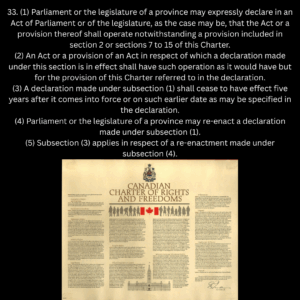
The Canadian Charter of Rights and Freedoms is a significant part of our Constitution and remains one of the most important documents in the fight to protect the citizens of Canada, our culture and our way of life.
We have all seen a recent announcement from Sean Fraser, Canada’s Minister of Justice and Attorney General, stating his intention to change certain aspects of our Charter permanently.
Many have reacted to this announcement with well-founded concerns, but we first need to understand exactly what Sean Fraser’s intentions are, and the way that he is attempting to do this, that bypasses the will of Canadians entirely.
Mr. Fraser is looking to change Section 33 of our Charter, known as the Notwithstanding Clause. This clause represents a necessary concession made at the time the Charter was drafted, requested by some provincial governments, with the intention of guaranteeing provincial autonomy when addressing urgent or regional issues, regardless of potential infringements against certain Charter rights in doing so.
The Supreme Court of Canada has the final word on whether a law infringes on the guaranteed rights of Canadians and thus, whether it should pass.
The notwithstanding clause gives the power back to the government enacting the law, providing that law with a 5 year window of protection against Charter challenges, once invoked. After this window closes, the law again becomes subject to Charter challenge in court.
The notwithstanding clause is not applicable in every case – it can only be invoked for infringements of sections 2, and 7 through 15 – those specific to our fundamental freedoms, legal and equality rights.
Prior to 2022, the notwithstanding clause had only been applied in a handful of cases since the Charter’s inception. Quebec has used this clause more than any other province, applying it to laws which support issues unique to Quebec culture such as their French language and secularism.
Ontario attempted to apply this clause to a law intent on limiting third party spending during elections; a law that was ultimately struck down due to its unintended impacts on other Charter rights.
Saskatchewan has applied this clause to pass a law forcing striking government workers back to work, showing its application in labour disputes.
Alberta is currently considering applying it to a law passed late last year which bans doctors from providing puberty blockers and hormone therapy to those under 16 years of age.
While these applications of the notwithstanding clause may be seen by some as controversial, repercussions fall directly on the government enacting the law, which typically results in significant political scrutiny. If enough voters disagree with the law in question, that government will lose favour and not be re-elected.
Simply put, the lack of legal justification reflects the nature of the clause’s intention – it avoids judicial oversight, relying on democratic accountability to keep governments in check.
This is different than Section 1 of our Charter, which requires a standard of proof to override Charter rights, specifically that the applied infringement be reasonably limited and demonstrably justified using the Oakes Test.
What Sean Fraser is arguing, to justify his efforts, is that the repeated use of the clause by any one government constitutes an indirect amendment of our Constitution. He is right, but fails to acknowledge the existing checks and balances already imposed by the 5 year term.
What isn’t mentioned is that this would significantly change the balance of power in Canada, between our levels of government and our judiciary, giving the Supreme Court the final say in every case. Provincial governments would lose their flexibility to address complex issues specific to their unique conditions and populations.
Sean Fraser is advocating for judicially imposed limits to the use of the clause. Even when the clause is invoked, he wants the Supreme Court to still have the ability to rule on whether the particular law violates Charter rights, in an effort to publicly shame the government enacting the law and pressure legislatures to repeal or amend them. This would expand judicial oversight beyond the clause’s explicit text. Using this judicial oversight he further proposes limiting and or restricting pre-emptive or repeated use.
The existing legal process, to make changes to our Constitution, involves a formal constitutional amendment under Section 38 of the Constitution Act. This requires the approval of the federal government and at least 7 provinces, representing 50% of Canada’s population; a process designed to ensure a broad consensus.
Rather than following this process, Mr. Fraser has taken advantage of the federal government’s ability to intervene in federal cases involving constitutional questions, as he did in Quebec’s Bill 21 Supreme Court challenge (Quebec’s secularism law). He filed a factum in the appeal of Bill 21, urging the court to impose substantive restrictions on Section 33 applications.
While he stated that he takes no position with the specific case of Bill 21, he nevertheless leveraged it, using the opportunity to force the Supreme Court to now decide on his proposed changes in their ruling, effectively imposing constitutional changes via court ruling, without legislative debate.
If the Court agrees, it would bind all provinces without needing their approval, limiting the clause’s power through precedent rather than repeal, again, with no parliamentary debate or public consultation.
Fraser proclaims that this decision “will shape how both federal and provincial governments may use the notwithstanding clause for years to come.”
He is not wrong.
The clause was specifically requested and installed to appease some provinces who expressed concern over the language and overreaching power it gave to the unelected judges. This clause represents a concession, protecting their autonomy to function as a province.
Removing or restricting its use, and giving the majority of authority to the judiciary, will alienate those provinces (and others) with the potential to throw us into a constitutional crisis; fracturing already strained relations between our levels of government.
Sean Fraser’s push has been seen as politically motivated, tied to Liberal discomfort with the increased application of the clause since 2022. This increase in applications by provincial governments can be seen as a clear signal of the tensions growing between our provincial and federal governments since the Liberals imposed such unjustified and unreasonable restrictions across all provinces during the pandemic.
This judicial route allows Fraser, and the Liberal government, to achieve Constitutional changes (making the clause politically or practically unusable), without the consensus-driven amendment process. Politically, it allows the Liberal government to claim themselves champions of our Charter rights while increasing their control over its application.
We have already seen enough evidence in the past 5 + years to demonstrate how much the Liberals truly support our Charter rights. The last thing Canadians need is to give more power to the unelected judiciary or the federal government.
Canada is a massive country with diverse landscapes, economies and lifestyles, stretching from coast to coast to coast. We are not all the same, our needs vary as do our values and choices.
We are all Canadians at heart, but our provincially elected leaders should continue to have the ability to address issues unique to their own citizens.
We believe that the Charter should be respected and supported in it’s original intent, and that the agreements and concessions made in good faith be honoured.
If Canadians truly support a change to our Constitution, then we should be able to say so through the legislative process in place for this effort. To force changes in the way he has goes against our entire established democratic systems.
The Supreme Court’s ruling is expected in 2026. We will be watching this closely and hope that you are as well.



0 Comments