
Emergencies Act Inquiry Hearings Recap- Week Five
Nov 19, 2022 | Blog, General News
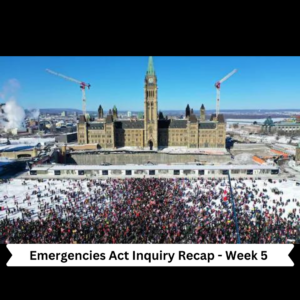
The Emergency Act Inquiry continued into its fifth week in Ottawa.
On November 18th, 2022, the CBC ran an article regarding a document from the Privy Council Office which was entered into evidence on Friday. The memorandum advised the Prime Minister that “the disturbance and the public unrest is being felt across the country and beyond the Canadian borders, which may provide further momentum to the movement and lead to irremediable harms, including social coercion, national unity, and Canada’s international reputation.” The Privy Council Office memorandum also states that in its view that the situation met the threshold that the security of Canada was threatened but that this interpretation could be susceptible to court challenge. The document was authored by Clerk of the Privy Council Janice Cherette on February 14th and sent to the Prime Ministers Office. Later that same day the Prime Minister invoked the Emergencies Act. Cherette testified at the inquiry this week and acknowledged that others may not share her view that the threshold was met to use the legislation. In response to RCMP Commissioner Brenda Lucki’s testimony Charette stated that if the head of the RCMP did not believe existing legislation had been exhausted that it should have been brought to her attention.
The same article also cites another member of the Privy Council Office, Deputy Nathalie Drouin, who has stated that she believed the use of the Emergencies Act was necessary.
Both Cherette and Drouin from the Privy Council office state that Municipal By-Law and Criminal Code violations were occurring, that all existing legislation had not been exhausted, but that the government was dissatisfied with the police response and operational plan to deal with the protest.
National Security Advisor Jody Thomas testified that the use of the act was necessary because of economic impact, violent rhetoric, and the growth of the protest. We saw border crossings cleared using court injunctions.
Why can one border be cleared with existing legal authority while the other needs the use of the emergencies act? Additionally, the size of the protest is irrelevant. Nowhere in the Charter does it speak of a limit on the number of people gathering to speak out against their governments policies. It is clear that the federal government was more concerned with their international reputation and the criticism their policies were facing nationally and abroad. As a result, there was a political need to quell the protests.
A National Post article from this week reported that CSIS told the federal government there was no evidence that the convoy posed a national security threat or that it was being funded or infiltrated by any foreign state. This information was provided to the Prime Minister on February 13th the day before the act was invoked.
This information contradicts statements made by Emergency Preparedness Minister Bill Blair who claimed strong evidence existed to believe that the convoy was being foreign funded and was a targeted and coordinated attack. This sort of contradiction makes it seem apparent that the Federal Liberals were just ignoring the position of CSIS and the RCMP. This is clear evidence that Minister Blair was lying to the public. Not surprising considering he was Chief of Police in Toronto during the G20 kenneling.
The importance of what the Canadian public is being told should not be understated. The Privy Council office is admitting that they knew the use of the act was questionable. The memorandum focused on what may happen instead of what was actually occurring. They speak of the movement gaining momentum, affecting national unity, and having a negative impact on the country’s international reputation. These all seem like political, not legal, reasons to violate Canadian’s rights. Decision’s that infringe on the Charter cannot be made based on “what ifs,” they need to be made taking into consideration “what is.”
The inquiry is also showing the public the absolute disconnects between bureaucrats, politicians, the legal system, the police, and the law. What this inquiry is telling citizens is that these important decisions are being made based on personal opinions, interpretations, and politics. Even the language that the individuals use to defend their actions is important. “May provide further momentum.”
When the word may is used it appears to be a way to justify courses of action that are constitutionally questionable. Further the fact that the government had a lack of faith in the police response is not justification to infringe on civil rights. If police leadership is incompetent, and the government is not satisfied with their response, this is not an acceptable excuse to limit freedoms. Maybe the disconnect between those testifying in favour of, or against, the use of the Emergencies Act was also present within police command. Could this be why Ottawa Police Chief Peter Sloly resigned hours before it was implemented? Was there political pressure on the police service to disband the protest? Undoubtedly there was, but the police are supposed to be independent of the state. They serve the citizens and uphold the Charter, in theory. Is this why Steve Bell replaced Sloly as Chief? Because he was willing to do something Sloly was not? These answers are something the inquiry may not provide but are worth considering when examining our institutions. What is absolutely clear is that there was a lack of consensus regarding the implementation of the act. Canadians expect that if the government is going to resort to extreme measures that those measures can be justified and that there is some semblance of consensus amongst those responsible for such important decisions.

0 Comments