
Canadian Constitution Foundation Files Notice of Application for Judicial Review Regarding Calgary’s Bylaw Prohibiting Certain Protests
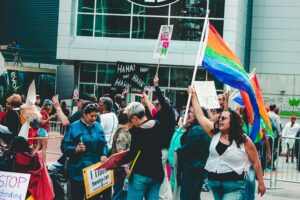
In March 2023, the City of Calgary passed the Safe and Inclusive Access Bylaw, banning specific protests around city-owned libraries and recreational facilities. While the City of Calgary (the City) claimed its purpose was purely to protect the safety of the LGBTQ+ populations, assuring them easy access to these facilities in response to a protest that erupted during a drag queen story time event at a local library, the language within the bylaw cannot be reconciled with that purpose.
The definition used to clarify the banning of “specified protests” reads, “An expression of objection or disapproval towards an idea or action related to…(race, gender identity etc.).” Who will define these vague umbrella terms of ‘expression’ or determine what it means to say something may be ‘related to’ a protected topic?
The Canadian Constitution Foundation (CCF) recognized these discrepancies and have called out the potential applications of such a vague and politicized policy, and the numerous ways in which it can be used to capture situations (and citizens) that have no connection to the City’s (apparent) intended outcome.
The CCF has launched a legal challenge against the City of Calgary over this new bylaw, arguing it violates fundamental freedoms guaranteed by the Canadian Charter of Rights and Freedoms and the Alberta Bill of Rights.
This bylaw, as reported by Christine Van Geyn (CCF), does not comply with natural justice or procedural fairness, using language that is intentionally vague and overly broad in its reach. The bylaw establishes a 100 metre “access zone”, prohibiting protests related to specific topics such as race, gender, gender identity, sexual orientation, or other protected characteristics under the Human Rights Act, within these zones during operational hours and for one hour before and after.
Penalties include fines up to $10,000 and imprisonment of up to one year, which the CCF points to as a severe restriction of free expression. From their perspective, this bylaw is unconstitutional because it engages in content-based discrimination, selectively restricting protests based on their subject matter while allowing others, such as environmental protests, to proceed in these same spaces. They argue that this violates Section 2(b) of the Charter (freedom of expression), as it prioritizes certain viewpoints over others, undermining the principle of content-neutral regulation.
CCF lawyer Yoav Niv has described the bylaw as “unprecedented” in Canada, asserting it was enacted in bad faith, rushed through without proper committee review, and is overly broad, potentially chilling a wide range of speech, including support for issues like opposing female genital mutilation, if tied to religious practices. The CCF also contends the bylaw exceeds municipal authority, as it treads into criminal law, a federal jurisdiction, and infringes on liberty rights by imposing jail time for speech-related offenses. They argue it fails the Section 1 Charter test, which requires restrictions on rights to be demonstrably justified in a free society. The bylaw’s vague enforcement criteria risks discriminatory applications, targeting protests deemed “undesirable” by officials. The CCF’s challenge, heard in February, in the Alberta Court of King’s Bench, seeks a judicial review to strike down the bylaw, emphasizing its threat to democratic discourse and public engagement.
The CCF provided arguments both in support of the Charter of Rights and Freedoms in addition to those for judicial review. Because of another case with similar Charter arguments, the court has chosen to apply a qualified stay against all Charter arguments, pending the outcome of the other case; a decision which benefits the City as the outcome of the other case affects only one individual, while the CCF case has the potential to set broad, binding precedent in support of all Canadians. The court however, did not restrict the CCF from supporting and intervening in the other case.
While the CCF’s arguments were restricted to judicial review proceedings only (at this point), these arguments remain robust and sound. They point to the Municipal Act, which clearly outlines the roles, responsibilities and authority that the City must work within. They point to existing legislation and bylaws that are fully established to address the potential issues that the City claims to be protecting against, while also showing that there was no effort to use these existing tools – rather, the City enthusiastically enacted new laws that encroach on the private lives and conversations of all citizens.
The CCF rightfully points out that both drag queen story time events and bathroom selection (based on someone’s chosen ‘identity’) are current “hot-button” issues across Canada and throughout much of the world, and that by creating and supporting these controversial events and actions, the City has effectively created the very situation for protests and disagreements to take place.
The City of Calgary is the first to try to enact such laws. They wrongly believe that any vagueness in their choice of language can be clarified case-by-case, something known as prosecutorial discretion; they seem unaware that the Supreme Court has previously determined that “an unreasonable or unconstitutional law” cannot be saved in this way.
The case has ended, but the decision has yet to be released. The status of the second Charter – focused case is unknown at this time. We remain hopeful, knowing that we must fight each of these infringements immediately and aggressively, lest we continue to lose our freedoms inch by inch to the overreach from all level of governance.
Again, our rights and freedoms are content-neutral. It matters not what you choose to say in order to have the right to say it. This is one of the most important rights we must protect in Canada. Without the freedom of speech and expression, we can be stripped of what rights remain and will find ourselves unable to have open conversation about any important matters. This is not the Canada we founded.
Stand with us in support of the amazing work of the CCF and the many other organizations and individuals who continue to show us what freedom should be.
To read the City of Calgary Safe and Inclusive Access Bylaw, click here
To read more from the Canadian Constitution Foundation, click here

0 Comments